

Why Your Business Feels Invisible Online Right Now
May 6, 2026
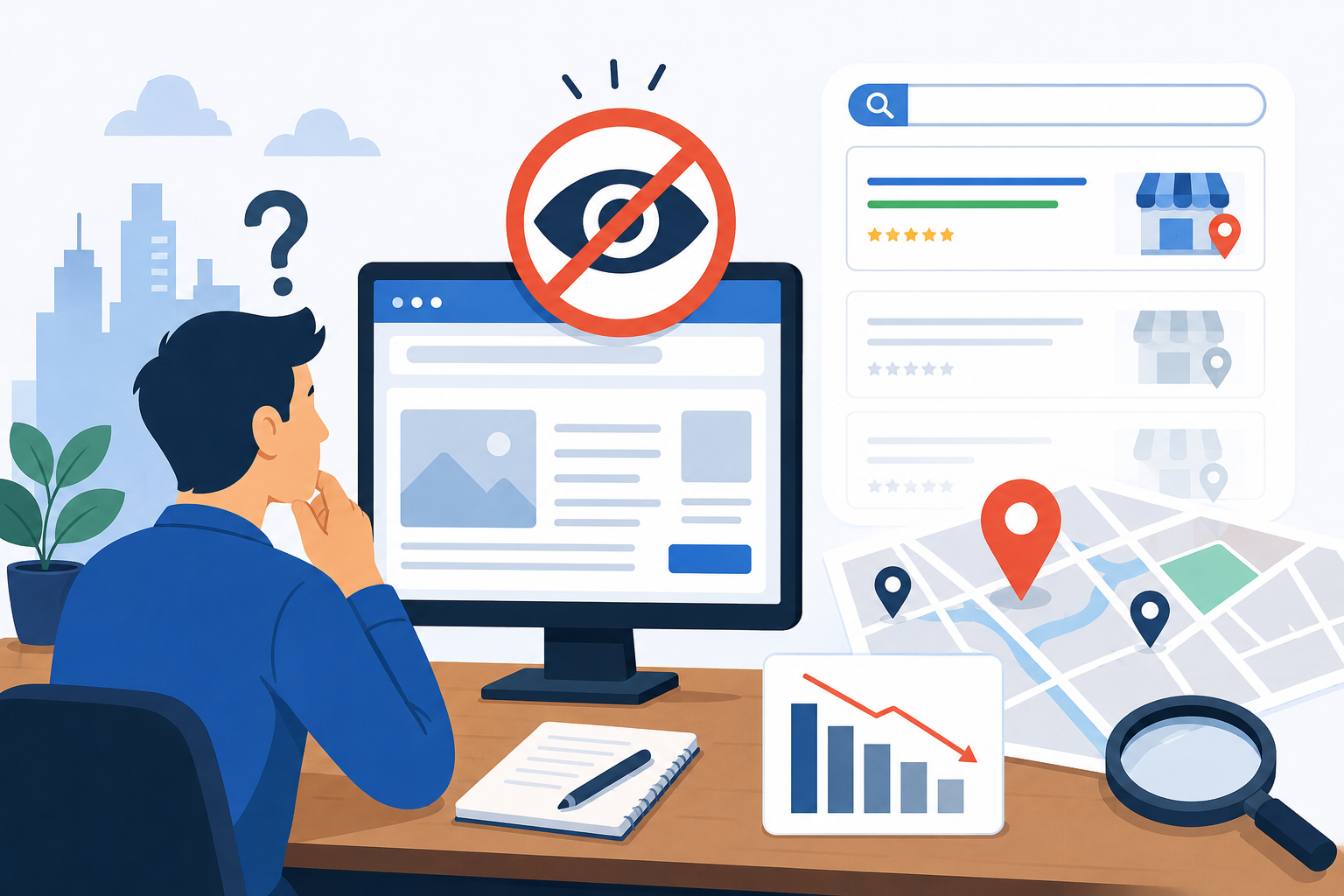
If your business is online but customers still are not finding you, you are not alone. Many businesses have a website, social media pages, and maybe even a few paid ads running, yet still struggle to show up where buyers are actually searching.
That kind of online invisibility can be frustrating. You know your services are valuable. You know your team can help. But if your website does not rank, your local listings are weak, your pages are outdated, or your competitors are easier to find, potential customers may never reach you.
The good news is that online visibility can be fixed. Once you understand why your business is not showing up, you can improve your SEO, website structure, content, local presence, and overall digital strategy in a way that brings in better traffic and stronger leads.
What It Means to Be Invisible Online
Being invisible online does not always mean your business cannot be found at all.
Sometimes it means you show up too low in search results. Sometimes your competitors appear on Google Maps while you do not. Sometimes your website ranks for the wrong keywords, attracts the wrong visitors, or fails to turn traffic into inquiries.
In other cases, people may find your business but leave quickly because your website looks outdated, loads slowly, or does not clearly explain what you offer.
Online visibility is not just about being present. It is about being discoverable, credible, and easy to choose.
Your SEO Foundation Is Too Weak
A common reason businesses disappear online is weak SEO groundwork.
SEO is not just about adding keywords to a page. It includes your website structure, page titles, meta descriptions, internal links, service pages, technical performance, content quality, and how clearly search engines understand your business.
If these basics are missing, Google may struggle to connect your website with the right searches.
For many businesses, sustainable growth starts with strong SEO foundations because every future campaign depends on how well your site is built, organized, and optimized.
Without that foundation, even good content can underperform.
You Are Targeting the Wrong Keywords
Not all keywords bring the right customers.
Some businesses target broad keywords that are too competitive. Others target terms that get traffic but do not match buyer intent. Some do not target keywords at all and simply hope Google figures it out.
That rarely works.
For example, a web design company should not only chase “web design.” It may also need location-based, service-specific, and problem-focused keywords like “website redesign for small business,” “local SEO web design,” or “business website development services.”
The goal is not just more traffic. The goal is qualified traffic.
When your keyword strategy matches what your ideal customers are already searching for, your visibility becomes much more valuable.
Your Website Does Not Clearly Explain What You Do
Search engines and customers both need clarity.
If your homepage is vague, your service pages are thin, or your website uses generic language, people may not understand why they should choose you.
Search engines also rely on page content to determine relevance. If your pages do not clearly explain your services, locations, industries, and value, your site may not rank well for important searches.
Strong service pages should answer basic questions quickly:
What do you offer?
Who do you help?
Where do you serve customers?
What problems do you solve?
Why should someone trust you?
What should they do next?
Clear content helps search engines rank your pages and helps visitors take action once they arrive.
Your Service Pages Are Outdated
Your service pages are some of the most important pages on your website.
They often target high-intent visitors who are actively looking for what you offer. But if those pages are outdated, too short, poorly structured, or missing important keywords, they may not perform well.
A strong service page should be specific, useful, and conversion-focused.
It should explain the service, address common pain points, include trust signals, answer objections, and guide the visitor toward contacting your team.
If your pages have not been reviewed in a while, it may be time to refresh service pages so they better match search intent and customer expectations.
Small improvements can make a big difference, especially when your competitors are actively updating their content.
Your Website Design Hurts Trust
Visibility does not end when someone clicks your website.
If visitors land on your site and immediately feel unsure, they may leave before reading your offer. Poor design can quietly damage trust, even when your actual service is excellent.
Outdated layouts, cluttered pages, weak visuals, confusing navigation, and inconsistent branding can make your business look less credible than it really is.
People judge websites quickly. If your site feels old, slow, or hard to use, they may assume your business is the same.
Good web design helps visitors feel confident. It makes your message easier to understand, your services easier to explore, and your calls to action easier to follow.
That is why design is not just about looking good. It directly affects conversions.
Your Website Loads Too Slowly
Speed matters more than many businesses realize.
A slow website frustrates visitors and can hurt search performance. If your pages take too long to load, users may leave before seeing your content.
This is especially important on mobile devices, where many customers search while they are on the go.
Common causes of slow websites include oversized images, poor hosting, too many plugins, messy code, unoptimized scripts, and outdated themes.
A fast website creates a smoother experience. It also gives your SEO strategy a stronger technical base.
If your business depends on leads, calls, bookings, or online sales, speed should not be ignored.
Your Local SEO Is Not Strong Enough
For local businesses, visibility often depends on local SEO.
That means showing up when people search for services near them, especially on Google Maps and local search results.
If your Google Business Profile is incomplete, your reviews are weak, your categories are wrong, or your business information is inconsistent across the web, you may lose visibility to competitors.
Local SEO also depends on location pages, service-area content, local keywords, citations, reviews, and proximity signals.
If customers search for your service in your area and your business is missing, your competitors are collecting leads that could have been yours.
Improving Google Maps visibility can help your business appear where local buyers are already ready to take action.
Your Competitors Are Investing More Than You
Sometimes your business is not invisible because you are doing everything wrong.
Sometimes your competitors are simply doing more things right.
They may have stronger content, better backlinks, faster websites, more reviews, clearer service pages, better local SEO, or a more consistent publishing strategy.
Online visibility is competitive. If other businesses are actively improving their websites while yours stays the same, they are likely to outrank you over time.
This is especially true in crowded markets where multiple businesses offer similar services.
When customers compare options, they often choose the business that appears more visible, polished, and trustworthy.
You Are Missing “Near Me” Search Opportunities
Many high-intent customers search with location-based phrases.
They may type things like “SEO company near me,” “web designer near me,” “website developer near me,” or “best marketing agency near me.”
These searches often come from people who are closer to making a decision. They are not just researching. They are looking for a provider they can contact.
If your website and local presence are not optimized for location-based intent, you may miss these valuable leads.
A strong local strategy should include optimized service pages, local landing pages, Google Business Profile improvements, customer reviews, and consistent business information.
In competitive markets, winning near me searches can be one of the most direct ways to increase qualified local leads.
Your Content Does Not Answer Buyer Questions
A website with only a few basic pages may not be enough to compete.
Customers often have questions before they contact a business. They want to understand pricing, timelines, process, results, risks, comparisons, and what makes one provider better than another.
If your website does not answer those questions, they may find answers from a competitor instead.
Helpful content builds trust before the sales conversation begins.
Blog posts, service guides, comparison pages, FAQs, case studies, and educational resources can all help your business appear in more searches.
More importantly, they help potential customers feel informed and confident.
Good content does not just attract traffic. It supports the buyer journey.
You Are Not Optimized for AI Search
Search is changing.
People are no longer relying only on traditional Google results. They are also using AI tools, answer engines, and AI-powered search features to discover businesses, compare options, and get recommendations.
That means your business needs clear, trustworthy, well-structured content that AI systems can understand and cite.
Traditional SEO still matters, but visibility now also depends on how well your brand is represented across credible pages, structured information, expert content, and consistent online signals.
Businesses that want to stay visible should understand how AI search strategy fits into the broader future of digital discovery.
The more clearly your expertise is explained online, the easier it becomes for both search engines and AI systems to recognize your relevance.
Your Website Has Technical SEO Problems
Technical SEO issues can hold back even the best-looking website.
You may have strong design and helpful content, but if search engines cannot crawl, index, or understand your site properly, your rankings may suffer.
Common technical SEO issues include:
Duplicate pages
Broken links
Missing title tags
Poor mobile performance
Indexing errors
Unclear site structure
No schema markup
Redirect problems
Slow page speed
Thin or duplicate content
These issues are often invisible to business owners but obvious in SEO audits.
Fixing them can improve how search engines read your website and how users experience it.
Your Calls to Action Are Too Weak
Visibility only matters if visitors know what to do next.
If your website does not guide people toward a clear action, you may lose leads even when traffic improves.
A strong call to action should be specific, visible, and easy to follow.
Instead of vague buttons like “Learn More,” consider action-focused language such as “Request a Website Audit,” “Book a Consultation,” “Get an SEO Plan,” or “Start Your Project.”
Your calls to action should appear naturally throughout your site, especially on service pages, landing pages, and high-intent content.
Make it easy for interested visitors to become leads.
You Are Not Building Enough Trust
People need trust before they contact a business online.
If your website lacks testimonials, case studies, portfolio examples, reviews, credentials, process details, or clear contact information, visitors may hesitate.
Trust signals help reduce uncertainty.
For SEO, web design, and web development services, potential clients often want proof that you can deliver. They want to see examples, understand your process, and feel confident that your team knows what it is doing.
This is where your website should work like a digital sales representative.
It should answer questions, show credibility, and make the next step feel safe.
Your Strategy Is Too Fragmented
Many businesses treat SEO, web design, and web development as separate tasks.
But online visibility depends on how well they work together.
SEO brings people in. Web design helps them trust you. Web development ensures the site works properly. Content explains your value. Conversion strategy turns visitors into leads.
If one part is weak, the whole system suffers.
For example, SEO can bring traffic to a poorly designed page, but that page may not convert. A beautiful website may still fail if it is not optimized for search. A fast website may not rank if the content is thin.
Growth happens when all parts support each other.
That is why many businesses eventually need a team instead of disconnected one-off fixes.
When to Hire a Team for SEO, Web Design, and Development
You may be able to handle small updates yourself in the beginning.
But as your business grows, your website needs to do more than simply exist. It needs to attract, explain, convert, and support your sales process.
It may be time to hire a team if:
Your website is not generating leads
Your rankings are not improving
Your competitors dominate local search
Your website looks outdated
Your pages load slowly
Your content does not reflect your services
Your leads are low-quality
You are unsure what to fix first
Your team lacks time or technical expertise
A skilled team can look at the full picture, not just one piece of it.
If you want support with SEO, web development, web design, and conversion strategy, it may be time to hire who can turn your website into a stronger growth channel.
Truly Flexible Digital Marketing Services for Every Budget
How to Start Becoming More Visible Online
You do not need to fix everything at once.
Start with the areas that have the biggest impact.
Review your website structure. Check whether your service pages clearly explain what you do. Look at your Google Business Profile. Test your site speed. Search for your main services and see where your competitors appear.
Then identify the biggest gaps.
For many businesses, the best first steps are:
Improve service pages
Fix technical SEO issues
Update website design
Optimize local SEO
Create helpful content
Strengthen calls to action
Build trust with reviews and proof
Track conversions properly
Once these pieces work together, your online presence becomes much stronger.
FAQ
Why is my business not showing up on Google?
Your business may not show up because your SEO foundation is weak, your website lacks relevant content, your Google Business Profile is incomplete, or competitors have stronger authority.
Technical issues, poor keyword targeting, and outdated service pages can also prevent your site from ranking.
How long does it take to improve online visibility?
SEO and organic visibility usually take time. Some technical fixes and local SEO updates can help quickly, but stronger rankings often take several months.
The timeline depends on your competition, website condition, content quality, and how consistently you improve your online presence.
Do I need SEO if I already have a website?
Yes. A website alone does not guarantee visibility.
SEO helps search engines understand your website, rank your pages, and connect your business with people searching for your services.
Without SEO, even a well-designed website may stay hidden.
Can web design affect SEO?
Yes. Web design can affect SEO through mobile usability, site structure, user experience, page speed, navigation, and engagement.
A website that looks good but performs poorly may struggle to rank and convert.
What is the difference between SEO and local SEO?
SEO focuses on improving your visibility in search results overall.
Local SEO focuses on helping your business appear for location-based searches, such as searches with city names or “near me” intent. It is especially important for service-area businesses, local companies, and brick-and-mortar locations.
How do I know if my website needs a redesign?
Your website may need a redesign if it looks outdated, loads slowly, is hard to navigate, performs poorly on mobile, has weak calls to action, or does not generate leads.
A redesign should improve both appearance and performance.
Should I hire one person or a full team?
It depends on your needs.
If you only need a small task, one specialist may be enough. But if you need SEO, web design, web development, content, tracking, and conversion improvements, a team is usually more effective.
A full team can connect strategy, design, development, and marketing into one system.
Conclusion
If your business feels invisible online, the problem is usually not one single thing.
It may be your SEO foundation, website structure, local presence, content, design, technical performance, or conversion strategy. More often, it is a combination of several small issues that quietly limit your growth.
The important thing is that online visibility can be improved.
With the right SEO strategy, stronger service pages, better web design, clean development, and a clearer path to conversion, your business can become easier to find and easier to trust.
When your website works the way it should, it stops being a digital brochure and starts becoming a real source of leads, customers, and growth.