

SEO vs Local SEO: What’s the Real Difference for Business?
September 29, 2026
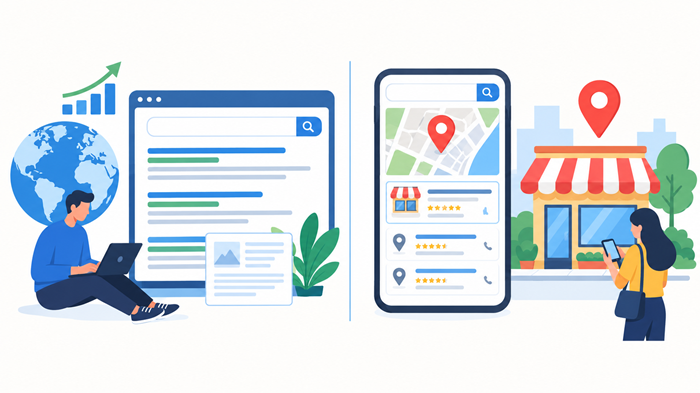
Understanding the difference between traditional search optimization and location-focused search can make a major difference in how a business attracts customers online. SEO vs local seo is not simply a matter of choosing one strategy over another. The two approaches share many fundamentals, but they target different search behaviors, ranking signals, and business goals. Understanding seo vs local seo helps businesses decide where to focus their time, content, website improvements, and online reputation efforts.
Key Takeaways
-
SEO generally targets broader searches, while local SEO focuses on customers searching for businesses in specific locations.
-
seo vs local seo depends largely on search intent, geographic relevance, and the type of customers a business wants to reach.
-
Local businesses can benefit from maps, reviews, location pages, and locally relevant content.
-
A balanced strategy can combine broad organic visibility with strong visibility among nearby customers.
What Is SEO?
SEO is the process of improving a website so search engines can better understand, evaluate, and rank its pages for relevant searches. It can involve content quality, website structure, technical performance, authority, links, user experience, and other ranking considerations.
The primary objective is to earn organic visibility for searches that are relevant to a business, organization, product, or topic. These searches do not necessarily have a geographic component.
For example, a software company might want to rank for searches related to project management tools, while a national retailer may target searches for specific product categories. A professional publisher could focus on informational queries that attract readers from many different regions.
The scope can therefore be broad. This is one of the clearest starting points for understanding seo vs local seo.
Businesses often work with digital marketing services to coordinate search optimization with content, advertising, social media, and other online growth activities.
What Is Local SEO?
Local SEO focuses on improving visibility for searches connected to a specific geographic area. The goal is to help potential customers discover relevant businesses, services, and physical locations when proximity or location is important to their search.
A person searching for a restaurant nearby, a dentist in a particular city, or an emergency plumber close to home has a different intent from someone researching a general topic.
This distinction is central to seo vs local seo because location becomes a meaningful part of relevance.
Local optimization can involve a business’s Google Business Profile, reviews, local landing pages, citations, location information, locally relevant content, website signals, and prominence within a particular market.
For businesses serving defined communities, strong visibility in geographically relevant searches can generate highly valuable leads.
SEO vs Local SEO: The Main Difference
The simplest way to understand seo vs local seo is to look at what each strategy is trying to accomplish.
Traditional search optimization generally aims to increase visibility across broader search results. Local optimization adds geographic relevance to that objective.
Consider two examples.
A company selling accounting software across the country might target searches related to accounting software features, pricing, integrations, and comparisons. Geographic proximity may have little importance.
An accounting firm serving one city has a different opportunity. Potential clients may search for an accountant near them or an accounting firm in their city. Location, reputation, proximity, and service relevance become much more important.
That difference explains why seo vs local seo should be viewed through the lens of search intent rather than as two completely unrelated disciplines.
Search Intent Changes the Strategy
Search intent describes what someone is trying to accomplish with a query.
Informational searches often seek explanations, guides, definitions, or comparisons. Commercial searches may indicate that someone is researching a product or service before making a decision. Local searches frequently show a need for a nearby business or provider.
A successful strategy starts by identifying those patterns rather than publishing content simply because a keyword has search volume.
This is also why understanding how seo brings long-term clients, not just traffic can help businesses think beyond rankings and measure the quality of visitors they attract.
SEO vs Local SEO: How Ranking Factors Differ
Search engines use numerous signals when determining which results are useful for a particular query. The importance of individual signals can vary depending on the search.
Traditional organic visibility may depend heavily on content relevance, website quality, authority, internal linking, technical accessibility, and external references.
Local visibility introduces additional considerations, particularly geographic relevance and business prominence.
For example, a local business may need accurate contact details, a complete business profile, genuine customer reviews, consistent location information, and strong relevance to the services people search for.
This makes seo vs local seo especially important for businesses that depend on customers within a particular service area.
Content and Website Relevance
High-quality content remains important in both approaches.
A website should clearly explain what the business offers, who it serves, and why its information is trustworthy. Service pages should provide useful details rather than simply repeating variations of a target phrase.
Location-based businesses can strengthen relevance through genuinely useful city, neighborhood, or service-area information. However, creating dozens of nearly identical pages with only place names changed can weaken quality and provide little value to readers.
Businesses should also understand on-page vs off-page seo because both areas contribute to a strong organic search foundation.
Reviews and Reputation
Reviews have a particularly visible role in local search. Customers often use ratings and written feedback when deciding which nearby business to contact.
Authentic reviews can provide potential customers with information about service quality, reliability, communication, and customer experience.
Businesses should focus on earning honest feedback through good service rather than attempting to manipulate ratings. Learning about the power of google reviews can provide additional context on why reputation matters in location-based search.
Which Businesses Need Local SEO?
Not every business needs a heavily location-focused strategy.
A national e-commerce company, software provider, online publisher, or organization serving customers across multiple countries may prioritize broader organic visibility.
A restaurant, law firm, medical practice, home-service provider, real estate agency, salon, contractor, or retail store may gain substantial value from local optimization.
The distinction in seo vs local seo becomes clearer when the customer journey is considered.
A customer looking for a nearby service provider often wants a solution quickly. They may check a map listing, read reviews, compare opening hours, visit a website, and make a call. Visibility during those moments can be highly valuable.
A broader organic strategy can still support that business by attracting people researching services, answering questions, and building long-term authority.
Google Maps and Local Results
Maps visibility is one of the most noticeable differences between broader organic search and local search.
A local search can produce map-based business results that include business names, locations, reviews, hours, websites, directions, and other information.
That creates a distinct opportunity for businesses with physical locations or defined service areas.
A useful local strategy should therefore consider local SEO strategies that help businesses dominate Google Maps results, while maintaining accurate business information and a website that supports the same service and location signals.
The objective should not simply be to appear in a map result. The larger goal is to make the business useful, credible, and easy to contact once a customer discovers it.
The Role of E-E-A-T
Trust matters across search marketing, especially when people are choosing a company to provide an important product or service.
Experience, expertise, authoritativeness, and trustworthiness are commonly discussed under the concept of E-E-A-T in SEO. Businesses can demonstrate these qualities through accurate information, qualified authors, transparent company details, useful service explanations, customer experiences, and credible references.
For local businesses, trust can also come through genuine reviews, recognizable local presence, consistent business information, and clear evidence of experience serving customers.
Understanding E-E-A-T in SEO can help businesses create content that demonstrates credibility instead of simply attempting to satisfy search algorithms.
Technical SEO Still Matters for Local Businesses
Local visibility does not eliminate the need for a technically sound website.
Search engines need to crawl and understand pages efficiently. Slow performance, broken links, poor mobile usability, confusing navigation, indexing problems, and weak site architecture can interfere with organic visibility.
This is where seo vs local seo can be misunderstood. Local optimization is not a replacement for website optimization. Instead, location-focused signals work alongside the broader technical and content foundation of a website.
Businesses can review technical SEO parameters to better understand the technical areas that support search performance.
SEO vs Local SEO: Can a Business Use Both?
Absolutely. In many cases, using both approaches creates the strongest strategy.
A local service company can create helpful educational content that attracts broader searches while also optimizing its core service pages for local customers.
For example, a roofing company could publish an article explaining common roof problems while maintaining strong service pages for the cities it serves. The informational article can attract people researching roofing issues, while location-focused pages can support customers who are ready to hire a provider.
This combined approach makes seo vs local seo less about choosing one side and more about assigning the right tactic to each customer journey.
When Broader SEO Should Take Priority
Broader optimization may deserve more attention when a business:
-
Serves customers nationally or internationally
-
Sells products online across multiple regions
-
Publishes educational or informational content
-
Offers software or digital services
-
Wants to build authority around a broad subject
-
Does not depend on physical proximity
The goal is to reach relevant audiences wherever they are searching.
When Local SEO Should Take Priority
Local optimization can be especially valuable when a business:
-
Has a physical storefront
-
Serves customers within a defined geographic area
-
Relies on phone calls, visits, appointments, or local inquiries
-
Competes with nearby businesses
-
Provides location-dependent services
-
Wants greater visibility in map-based searches
For these businesses, local seo can connect search visibility with real-world customer demand.
Common Mistakes Businesses Make
One common mistake is treating every search query as though it has the same intent.
A business may create a page targeting a city without providing meaningful information about that location. Another may focus heavily on broad informational content while neglecting its business profile, reviews, service pages, and local reputation.
Keyword repetition is another problem. Search optimization should not mean forcing the same phrase into every heading and paragraph.
Quality, relevance, usefulness, and consistency matter more than mechanical repetition.
Another mistake is measuring success only through rankings. Traffic, qualified leads, calls, appointments, direction requests, conversions, and customer acquisition costs provide a much clearer picture of business impact.
SEO vs Local SEO Explained in Practical Terms
A simple way to remember seo vs local seo is this:
Broad SEO asks, “How can this website become more visible for relevant searches?”
Local optimization asks, “How can this business become more visible to relevant customers in its service area?”
Both questions lead toward the same larger goal: connecting people with useful businesses, services, products, and information.
The difference is primarily the audience, geographic intent, and ranking environment.
Businesses searching for professional seo services should therefore define their target market before selecting a strategy. Working with a local seo company can make sense for businesses whose growth depends heavily on customers within a specific region.
Final Thoughts
The difference between the two approaches becomes much easier to understand when search intent and customer behavior are placed at the center of the strategy. seo vs local seo is ultimately about where potential customers are searching, what they need, and whether location influences their decision.
For a nationwide company, broad organic visibility may be the priority. For a neighborhood restaurant, contractor, law firm, or service provider, local visibility can be far more commercially important.
The strongest strategy often combines both. A technically sound website, useful content, credible information, strong reputation, and accurate local signals create a foundation that can support sustainable search visibility.
Rather than asking which approach is universally better, businesses should ask which searches matter most to their customers. That perspective makes seo vs local seo a practical business decision instead of simply an SEO terminology question.
Frequently Asked Questions
1. What is the difference between SEO and local SEO?
SEO targets broader organic searches, while local SEO focuses on improving visibility for geographically relevant searches.
2. Is local SEO part of SEO?
Yes, local SEO uses many standard optimization principles while adding geographic and business-location signals.
3. Does every local business need local SEO?
Businesses that depend on customers in a specific area can benefit significantly from a focused local search strategy.
4. Can a business use SEO and local SEO together?
Yes, combining broader organic content with location-focused optimization can support multiple stages of the customer journey.
5. Which is better, SEO or local SEO?
Neither is universally better; the right approach depends on the business model, audience, service area, and search intent.