

App Development Risks: How to Identify and Mitigate Them
September 1, 2026
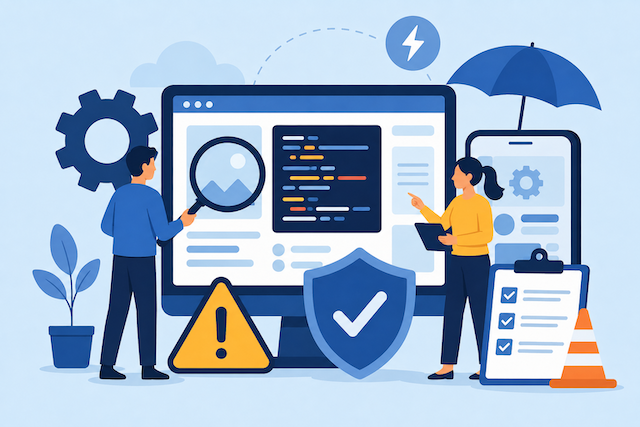
App development risk is the chance that something goes wrong during the build — and stops your app from launching, working reliably, or making money. Identifying these risks early is what separates projects that ship on time from ones that quietly drain budgets for months.
Key Takeaways
- App development projects fail at a high rate — research has consistently found that only around a third of software projects are completed successfully on time and on budget, though the precise figure varies by report year and methodology.
- The most expensive risks are discovered late; research consistently shows that identifying them during scoping and planning significantly reduces remediation costs — often by multiples compared to fixing the same issues post-launch.
- Technical debt, scope creep, security vulnerabilities, and third-party dependency failures are the four categories responsible for the majority of development failures.
- A risk management plan is not optional for any serious app build — it should be a formal deliverable before development begins.
- Choosing the wrong development partner compounds every other risk on this list; vetting processes matter as much as technical specifications.
- Platform fragmentation — the diversity of devices, OS versions, and screen sizes — remains a persistent operational risk, particularly on Android, where hardware and OS variation continues to present challenges.
What Are the Main Categories of App Development Risk?
App development risk falls into four distinct categories, each with its own causes, early warning signs, and mitigation strategies. Conflating them leads to generic checklists that miss the actual failure points in real projects.
Technical Risk
Technical risk covers everything that can go wrong with the code, architecture, and infrastructure itself. The most common technical failures include choosing the wrong technology stack for the use case, underestimating API integration complexity, and building on architectural assumptions that break under real load.
Architecture decisions made in week one determine whether an app can scale in year two. Choose wrong early, and you pay to rebuild later. A choice between React Native and Flutter, for example, is not merely a developer preference — it affects performance benchmarks, access to native device features, and long-term maintenance overhead.
Third-party dependencies introduce a category of technical risk that many teams underestimate. When a payment gateway, mapping service, or authentication provider updates its API or changes its pricing structure, every app built on top of it is affected. Teams that rely heavily on external services without abstraction layers face compounding risk. The longer the dependency chain, the greater the exposure.
Financial Risk
Financial risk in app development is rarely about the initial budget alone. The more dangerous figure is the total cost of ownership over 24–36 months post-launch. This includes hosting, maintenance, security patching, feature additions, and compliance updates.
Hiring a mobile app development agency can cost anywhere from $25,000 to over $500,000 depending on scope and complexity — though figures vary and should be verified against current published data for your region. But many organisations miss the ongoing cost — maintaining an app is widely estimated to run roughly 15–20% of the original build cost every year, though this varies considerably based on app complexity, platform, and team structure.
Cost overruns almost always trace back to scope creep. Requirements expand after the project starts. The timeline and budget don’t. A formal change control process — where every scope addition is costed and approved before it enters the backlog — is the single most effective financial risk control available.
Operational Risk
Operational risk covers the human and process failures that derail projects independently of any technical issue. Team turnover mid-project, communication gaps between client stakeholders and developers, unclear ownership of decisions, and inadequate testing environments all sit in this category.
The in-house versus outsourced development decision directly shapes operational risk. In-house teams offer tighter communication and faster iteration but introduce hiring risk and capacity constraints. Outsourced teams provide specialist skills and scalability but require more rigorous documentation, clear handoff protocols, and contract structures that align incentives.
Security and Compliance Risk
Security risk in app development is not limited to data breaches after launch. It begins during development. Sensitive data gets handled in test environments without access controls. API keys are hardcoded into repositories. Authentication flows are built incorrectly.
Mobile application security testing should be integrated throughout the development lifecycle — not bolted on as a final pre-launch check. Apps handling payment data may be subject to PCI DSS standards — though the scope of compliance depends on how payment processing is implemented; apps that delegate processing entirely to third-party providers like Stripe typically have a reduced PCI footprint. Apps that are operated by HIPAA-covered entities or their business associates and that handle protected health information must align with HIPAA requirements — but not all consumer health apps fall within HIPAA’s scope, and legal advice should be sought to determine applicability. Apps that process personal data of individuals located in the EU or EEA must comply with the General Data Protection Regulation (GDPR), regardless of where the app operator is based. Missing these requirements creates legal exposure. It can also force full architectural rebuilds — far more expensive than building compliance in from day one.
How Does Scope Creep Become a Risk Multiplier?
Scope creep is the single most consistent predictor of project failure across app development engagements of every size. It is not just a financial risk — it multiplies technical, operational, and security risks simultaneously.
When new features are added mid-development without formal impact assessment, developers adapt the existing architecture rather than redesigning it. This creates technical debt: workarounds, shortcuts, and undocumented code that functions in the short term but becomes increasingly fragile as the codebase grows. Understanding what affects app development cost means understanding that unchecked scope expansion is the primary driver of budget overruns.
The practical defence against scope creep is not a rigid refusal to evolve the product — it is a documented process for evaluating change requests. Every addition should trigger a formal assessment: what it costs in developer time, what technical debt it introduces, whether it delays the launch date, and whether it requires revisiting decisions already made in other parts of the codebase.
A minimum viable product (MVP) approach mitigates scope creep by forcing prioritisation before development begins. Teams that validate their app idea with actual users before building the full feature set consistently ship faster and with fewer wasted resources.
What Happens When You Choose the Wrong Development Partner?
Partner selection is the highest-leverage risk decision in any app project. The wrong choice does not just delay delivery — it can produce an app that cannot be maintained, extended, or even understood by a subsequent team.
Warning signs during the evaluation process include:
- Vague responses to technical questions about architecture or testing strategy
- No documented development process or project management methodology
- Reluctance to provide references from clients with comparable project complexity
- Fixed-price contracts that make no provision for discovery or change requests
- Portfolios that cannot be verified through the App Store or Google Play
The evaluation process should include a technical discovery session where the prospective partner proposes an architecture for your specific requirements. How they respond to constraints, edge cases, and questions about scalability reveals far more than a sales presentation.
When evaluating whether professional app development justifies its cost, the comparison is not the agency fee versus the cheapest available option — it is the agency fee versus the full cost of a failed or underperforming build, including the opportunity cost of months spent rebuilding.
Technical Debt: The Risk That Compounds Silently
Technical debt is the cost of shortcuts and deferred maintenance in a codebase. It builds slowly and silently. Eventually, it makes new development expensive and slow.
The debt is created at predictable moments:
- When developers are under deadline pressure and skip writing automated tests
- When new features are added without refactoring the existing code that they depend on
- When third-party libraries are not updated as security vulnerabilities are disclosed
- When documentation is perpetually deferred because it is treated as a non-billable task
- When the team that built the original system leaves and institutional knowledge disappears
Testing and QA processes are the primary mechanism for controlling technical debt accumulation. Automated test suites make it safe to refactor code because regressions surface immediately. Without them, every change to the codebase carries the risk of silently breaking existing functionality.
The practical implication for budget holders is that technical debt has a cost-of-carry. An app weighed down by debt costs more to maintain each year. It responds slowly to competitive changes. Unpatched code lingers in production, raising security risk.
Platform and Device Fragmentation Risk
Platform fragmentation is a persistent and growing source of operational risk in mobile app development. As of 2026, Android devices run across hundreds of hardware configurations and multiple active OS versions simultaneously. iOS fragmentation is lower but not absent — Apple’s annual major OS releases regularly introduce breaking changes to APIs and system behaviours.
The fragmentation risk manifests in three ways:
| Risk Type | Description | Mitigation |
|---|---|---|
| OS version incompatibility | Features that work on current OS versions break on older ones still in active use | Define minimum supported OS versions before development begins |
| Hardware variation | Screen sizes, camera capabilities, and processing power vary significantly across the device ecosystem | Test on a representative range of physical devices, not just simulators |
| Platform policy changes | App Store and Google Play policy updates can require emergency code changes or result in delisting | Monitor platform policy communications and maintain a responsive update pipeline |
The key stages of app development should include a formal compatibility matrix — a documented decision about which OS versions and device types the app will support, and how that support will be maintained over the product lifecycle.
How to Build a Practical Risk Management Plan
A risk management plan for an app development project does not need to be a lengthy document. It needs to be specific, actionable, and reviewed at regular intervals throughout the project.
A functional risk register for an app project contains:
- Risk identification — A named list of every risk that could affect the project, categorised by type (technical, financial, operational, security)
- Probability assessment — A rating for how likely each risk is to materialise, based on the project’s specific characteristics
- Impact assessment — A rating for how severely each risk would affect the project if it did materialise
- Mitigation actions — Specific, assigned actions that reduce either the probability or the impact of each risk
- Owner assignment — A named individual responsible for monitoring each risk and triggering the mitigation action
- Review schedule — A fixed cadence (typically fortnightly for active development projects) at which the register is reviewed and updated
The most common failure in risk management is treating the register as a one-time exercise. Risk profiles change as projects evolve — a risk that was low probability in the planning phase may become high probability after a key team member departs or a third-party API changes its terms.
Understanding why apps fail consistently points back to risks that were identifiable in advance but were never formally documented or assigned to an owner.
Frequently Asked Questions
What is the biggest risk in app development?
Scope creep is the most consistent cause of app development failure across project sizes and industries. It begins as small, apparently reasonable additions to the original specification and compounds into budget overruns, architectural compromises, and delayed launches. Controlling it requires a formal change management process before development begins.
How do you reduce security risk in a mobile app?
Security risk is reduced through a combination of secure coding standards from the outset, regular dependency audits to catch outdated libraries with known vulnerabilities, penetration testing before launch, and mobile application security testing integrated into the development cycle rather than treated as a pre-launch checkpoint. Apps handling sensitive data should also implement certificate pinning, proper session management, and encrypted local storage.
What is technical debt and why does it matter for app projects?
Technical debt is the accumulated cost of shortcuts and deferred maintenance within a codebase. It matters because it compounds over time — the longer it is left unaddressed, the more expensive and risky it becomes to modify the application. Teams that do not budget for periodic refactoring and debt reduction will find their app increasingly difficult and costly to maintain within 18–24 months of launch.
How much does poor partner selection actually cost?
The direct costs include the fees paid to a partner who fails to deliver, plus the cost of restarting the project. The indirect costs — delayed market entry, lost customer acquisition, and the internal resource time spent managing a failing engagement — typically exceed the direct costs significantly. In competitive markets, a six-month delay caused by a failed development partnership can represent a permanent loss of market position.
Should you use an MVP approach to reduce development risk?
Yes. An MVP approach forces prioritisation of the features that deliver core user value before anything else is built. This reduces financial risk by limiting initial investment, reduces technical risk by keeping the codebase smaller and more coherent, and reduces market risk by enabling user feedback before full investment is committed. The MVP should be a deliberately scoped, functional product — not a cut-price version of everything originally planned.
What is the role of ongoing maintenance in managing app development risk?
Post-launch maintenance is where risks that were not addressed during development materialise in production. OS updates break existing functionality. Security vulnerabilities are disclosed in libraries the app depends on. User behaviour reveals performance issues that testing did not surface. Budgeting for ongoing support and app longevity from the outset — rather than treating it as a future decision — is a direct risk control measure.
The most effective risk management in app development is front-loaded: the decisions made during scoping, partner selection, and architectural planning determine the majority of outcomes. Before committing budget to development, conduct a formal risk assessment, define your MVP scope in writing, and verify that your development partner has a documented process for each of the risk categories above. That investment in planning costs a fraction of what a single avoidable failure costs to remediate.